
Baked Zeppole di San Giuseppe
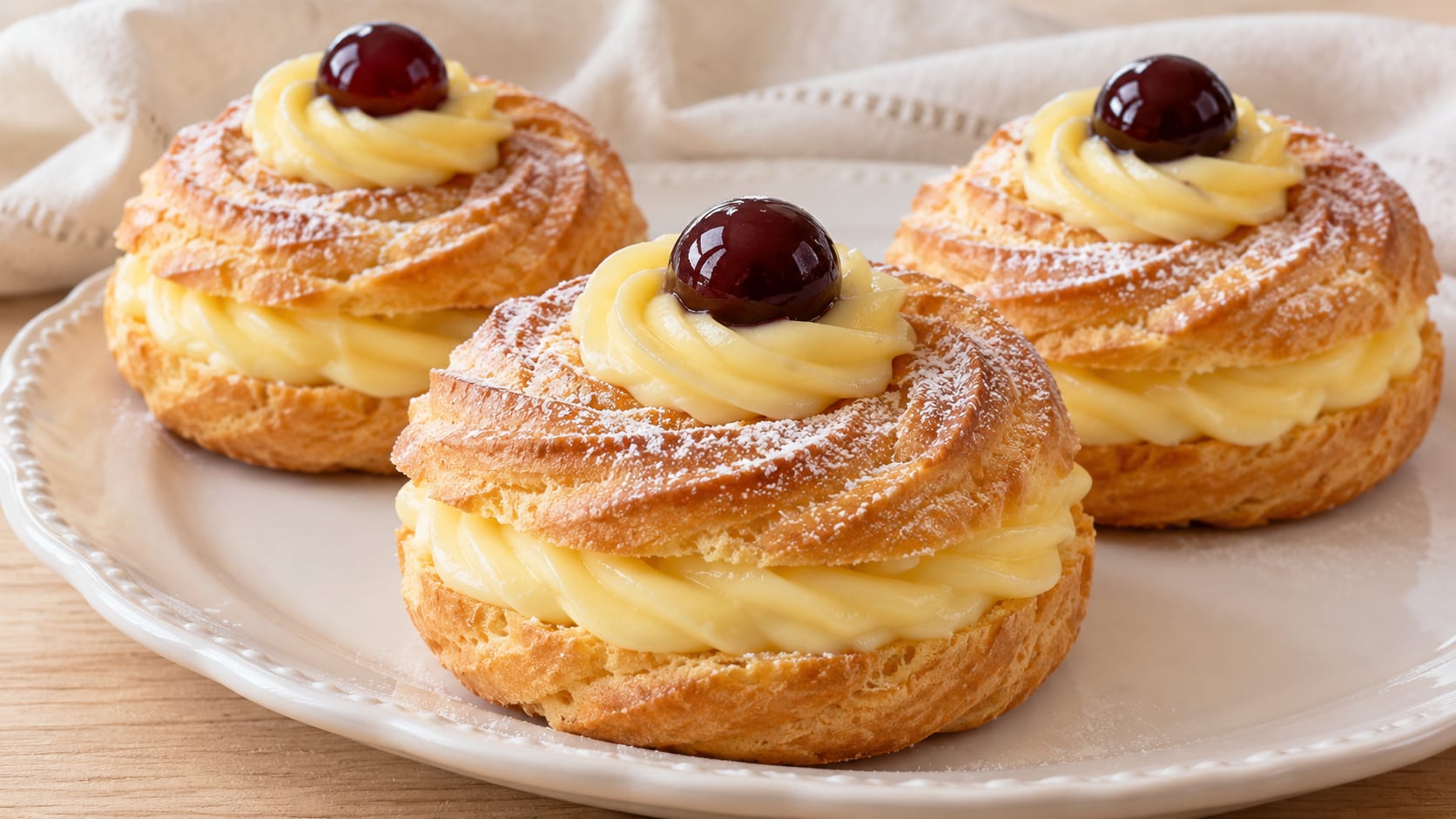
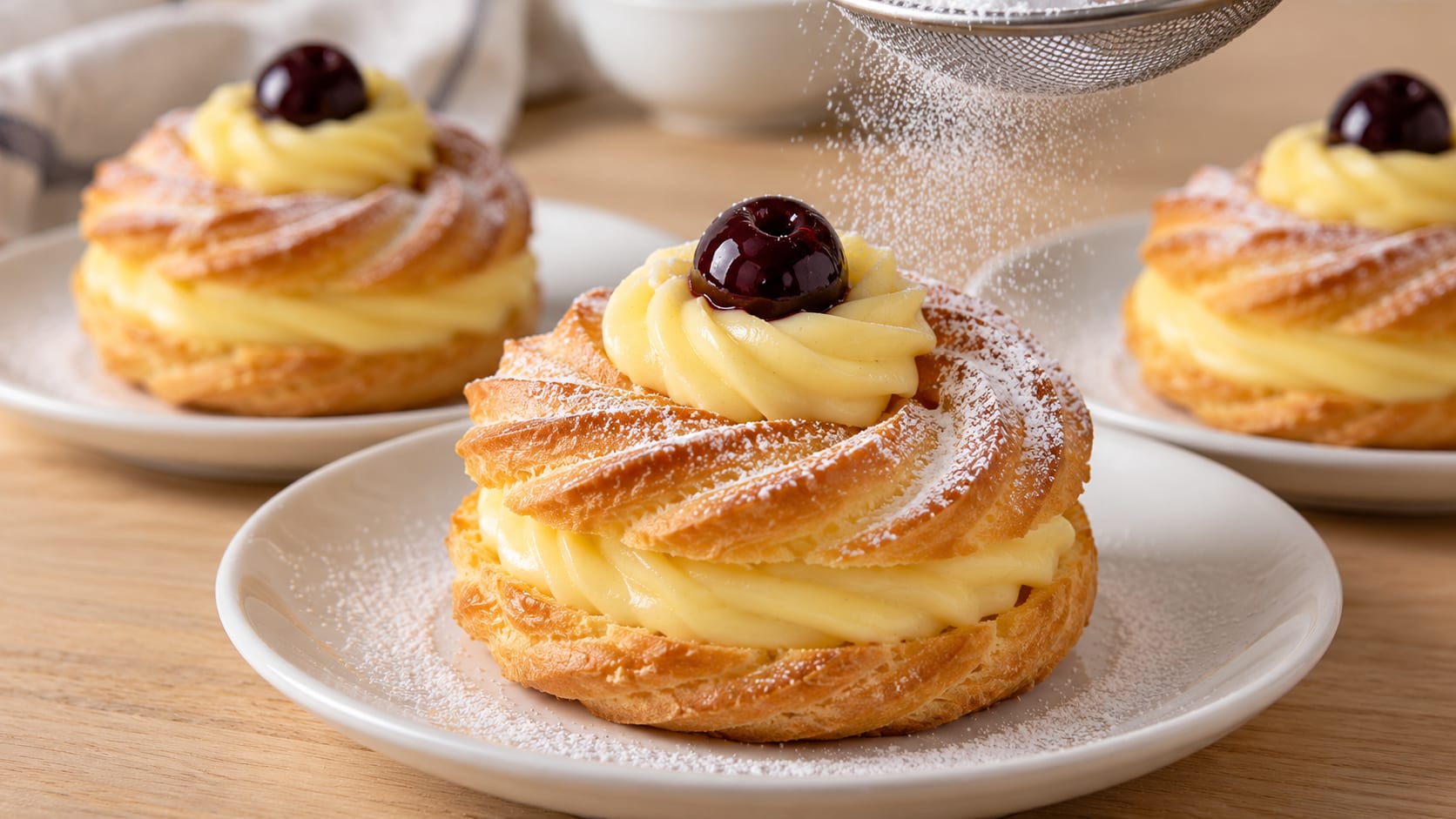
Golden ridged choux rings filled with vanilla pastry cream, finished with a dark syrup cherry and a light dusting of sugar. Eight Italian bakery-style pastries made in the oven.
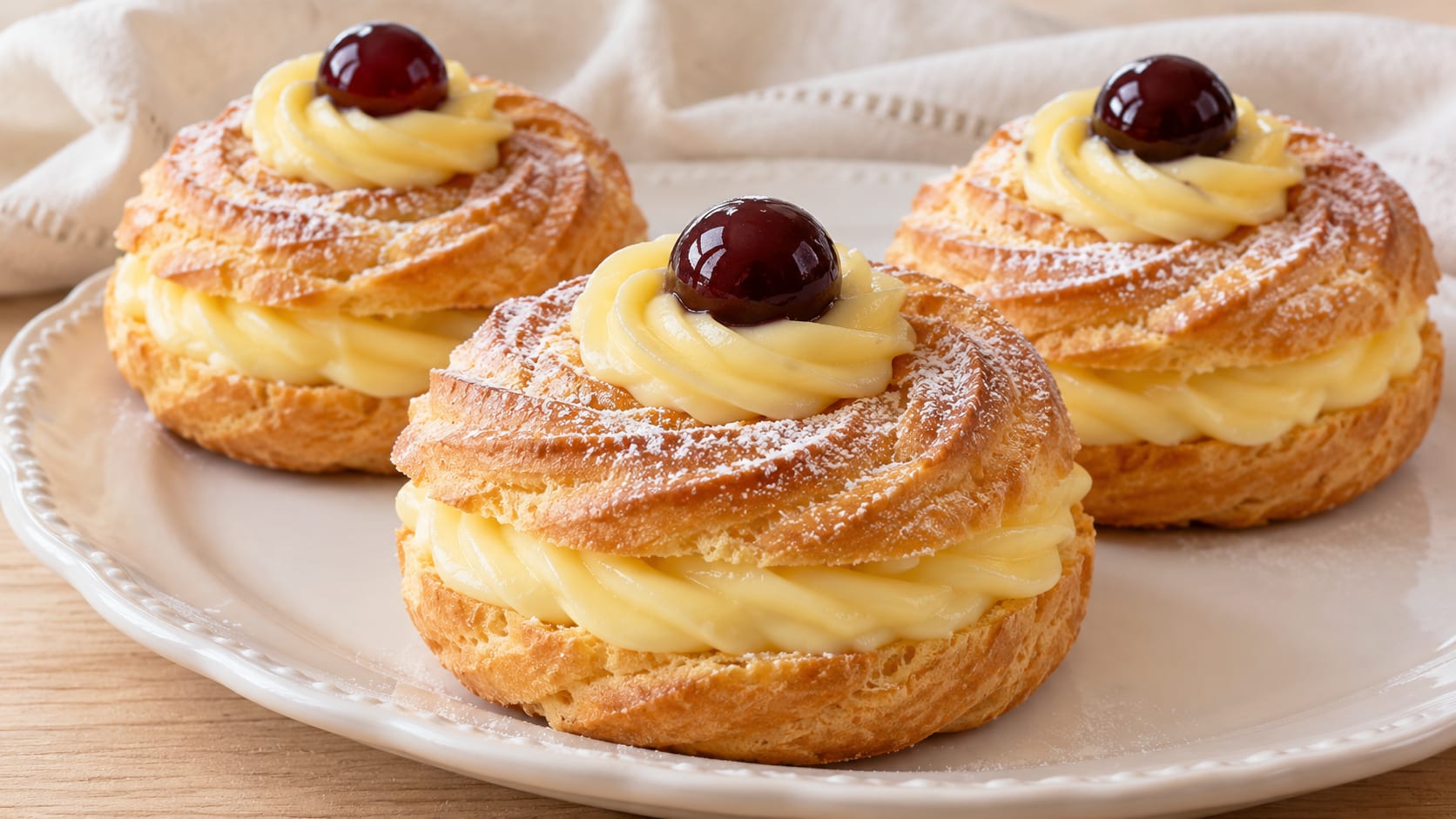
Zeppole di San Giuseppe pair ridged choux pastry with pastry cream and a cherry on top. This version is baked, with an airy shell and a vanilla custard filling. It makes eight medium pastries that are best assembled close to serving.
Make the cream first so it can chill while you prepare the rings. The final little portion of egg for the choux is added by consistency: stop when the dough falls from the spatula in a thick V. That small check matters more than forcing every drop into the bowl. This original formulation has not been kitchen-tested.
Why you’ll love this recipe
The flour is cooked in the butter-and-water mixture before eggs are added. This panade holds moisture that turns to steam in the oven, lifting the rings without yeast or baking powder. Gradual egg additions control the piping consistency. A drying stage and complete cooling help the shells support the cold pastry cream.
Before you start · Equipment
Kitchen scale, two saucepans, bowls, whisk, spatula, shallow heatproof dish, food thermometer, piping bags, 14 mm open-star nozzle for choux, medium star nozzle for cream, large baking tray with at least 44 x 26 cm usable space, parchment, cooling rack, small serrated knife and fine sieve.
Everything you’ll need.
Get your ingredients ready, then follow the quantities in the recipe below.
See ingredient amounts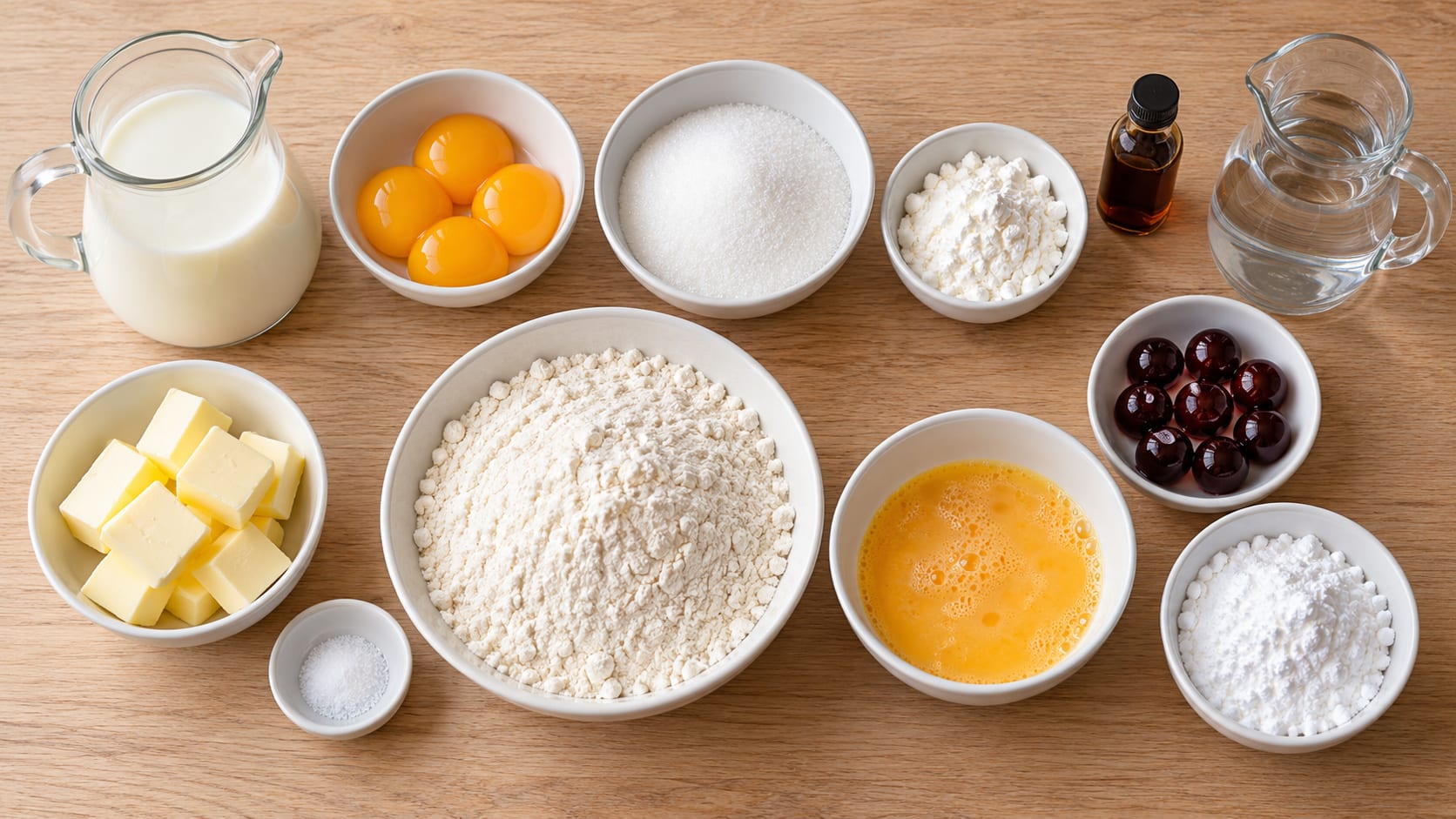
This guide describes the original 8 filled zeppole. Use the recipe card for amounts adjusted to your chosen yield.
Choose the baked San Giuseppe style
These zeppole are choux rings with vanilla pastry cream and a cherry. The oven method gives a different shell from fried yeast-dough zeppole. This recipe is written specifically for the baked ring style.
Start with the cream
A shallow container helps the custard cool before refrigeration. It should be cold and firm before you fill a piping bag. The two-hour chill can overlap the choux preparation and baking; the displayed times are planning allowances rather than a precise stopwatch total.
Recognize the panade
When the flour is stirred into the hot water and melted butter, it becomes a single dough that pulls away from the pan. Dry it briefly, then let strong steam escape before beating in eggs.
Watch the final egg addition
An extra teaspoon can change choux from ridged and pipeable to runny. Add the last portion slowly and stop at a thick V. Discard unused egg safely or refrigerate promptly for another fully cooked use; it is not used to glaze the pastries.
Let the shells set before venting
Opening the oven too early can deflate a soft shell. Wait for a firm golden exterior, then vent and dry. A wet center needs more drying time before the rings cool.
Assemble close to serving
Split cold shells and share all the pastry cream between the interior and top rosette. One dark cherry and a light sugar dusting complete each pastry. Filled choux softens during refrigeration, so same-day serving gives the best texture.
About the ingredients
- Weighed whole eggs
The choux starts with 150 g beaten whole egg, followed by up to 30 g only as needed. Drying the panade and flour absorption change the final requirement. The V test and a ridge that holds matter more than using all the measured egg. Nutrition uses the full 180 g as a conservative ingredient allowance.
- Yolks and cornstarch
The custard uses a separate 60 g yolk portion and 30 g pure cornstarch. Whisk the starch into the yolk-and-sugar paste before tempering. It thickens on the stove and must be fully cooked and chilled.
- Butter and plain flour
All 75 g butter and 125 g plain flour go into the choux. There is no baking powder, yeast, extra flour for dusting, frying oil or egg wash. The rings rise from steam during baking.
- Milk and vanilla
Use 350 g pasteurized whole milk. Stir in 4 g vanilla extract after cooking the cream. No whipped cream, mascarpone, ricotta or chocolate is included.
- Dark syrup cherries
Use eight small pitted dark cherries, approximately 40 g after draining. Amarena-style cherries suit the topping. Extra syrup is not poured over the pastries. Check the jar label for allergens and additives.
- A measured sugar finish
Use 70 g granulated sugar in the custard and 12 g icing sugar for the completed batch. The choux contains no added sugar. Do not add unmeasured sugar to the dough.
How to make Baked Zeppole di San Giuseppe
Cook and chill the vanilla pastry cream. Cook a flour panade, cool briefly and beat in eggs gradually to a thick V consistency. Pipe eight double-height rings. Bake at 200°C/390°F conventional, then lower to 180°C/355°F; vent only once firm and dry briefly. Cool fully, split horizontally, add cold pastry cream inside and on top, then finish each with one cherry and the measured icing sugar.
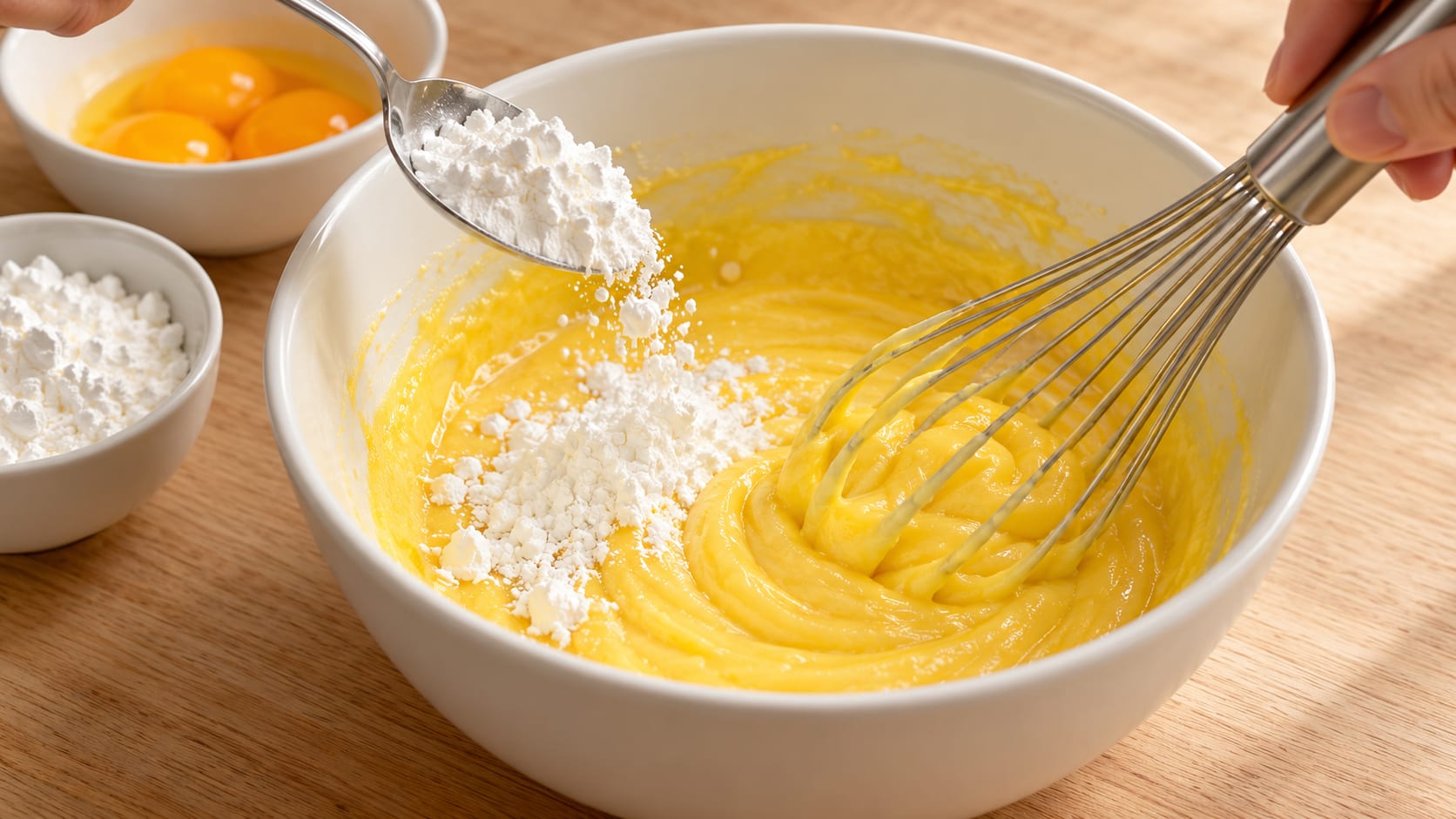 1. Mix the yolks; temper with hot milk
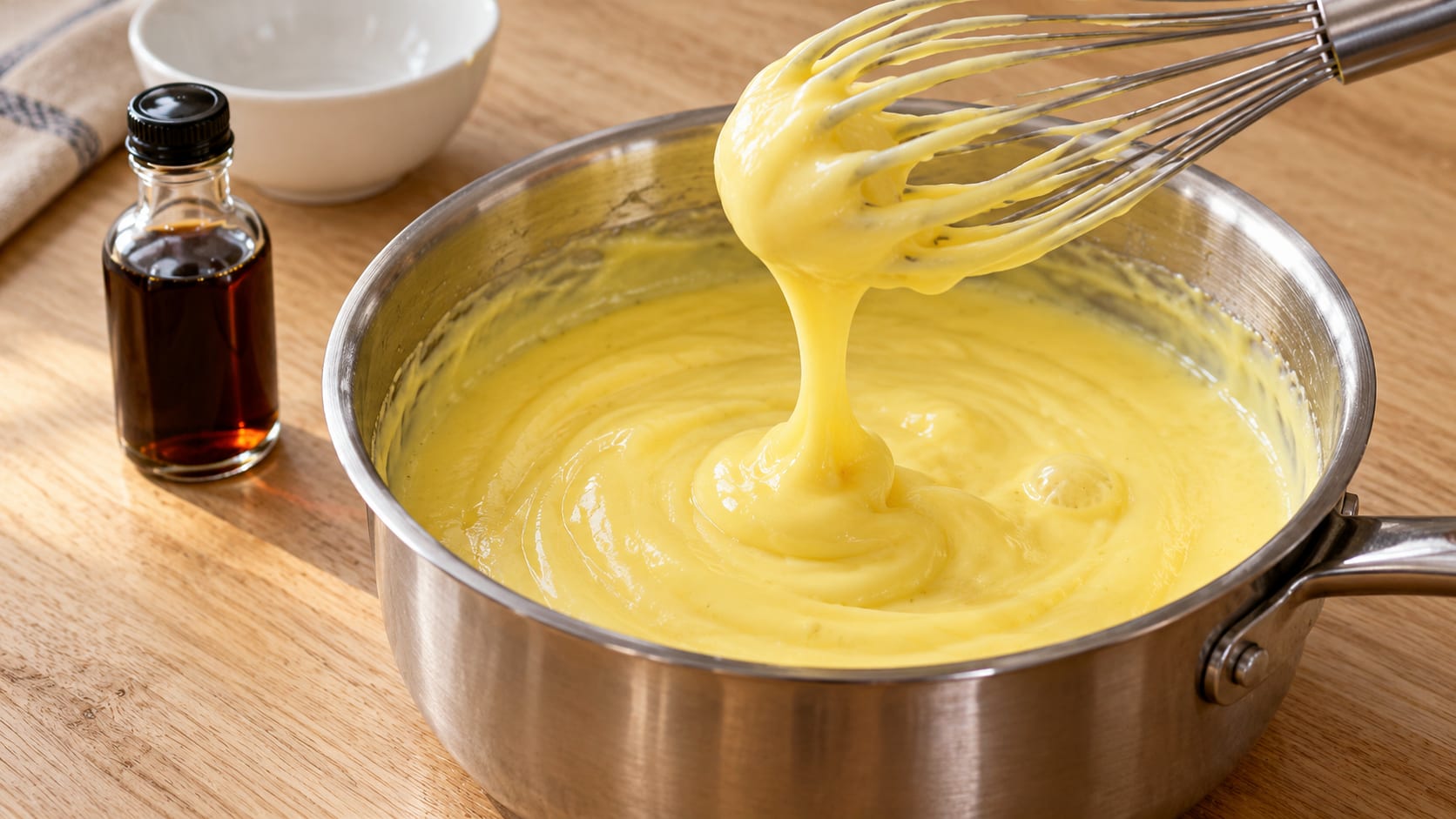 2. Cook the vanilla cream and chill it thoroughly
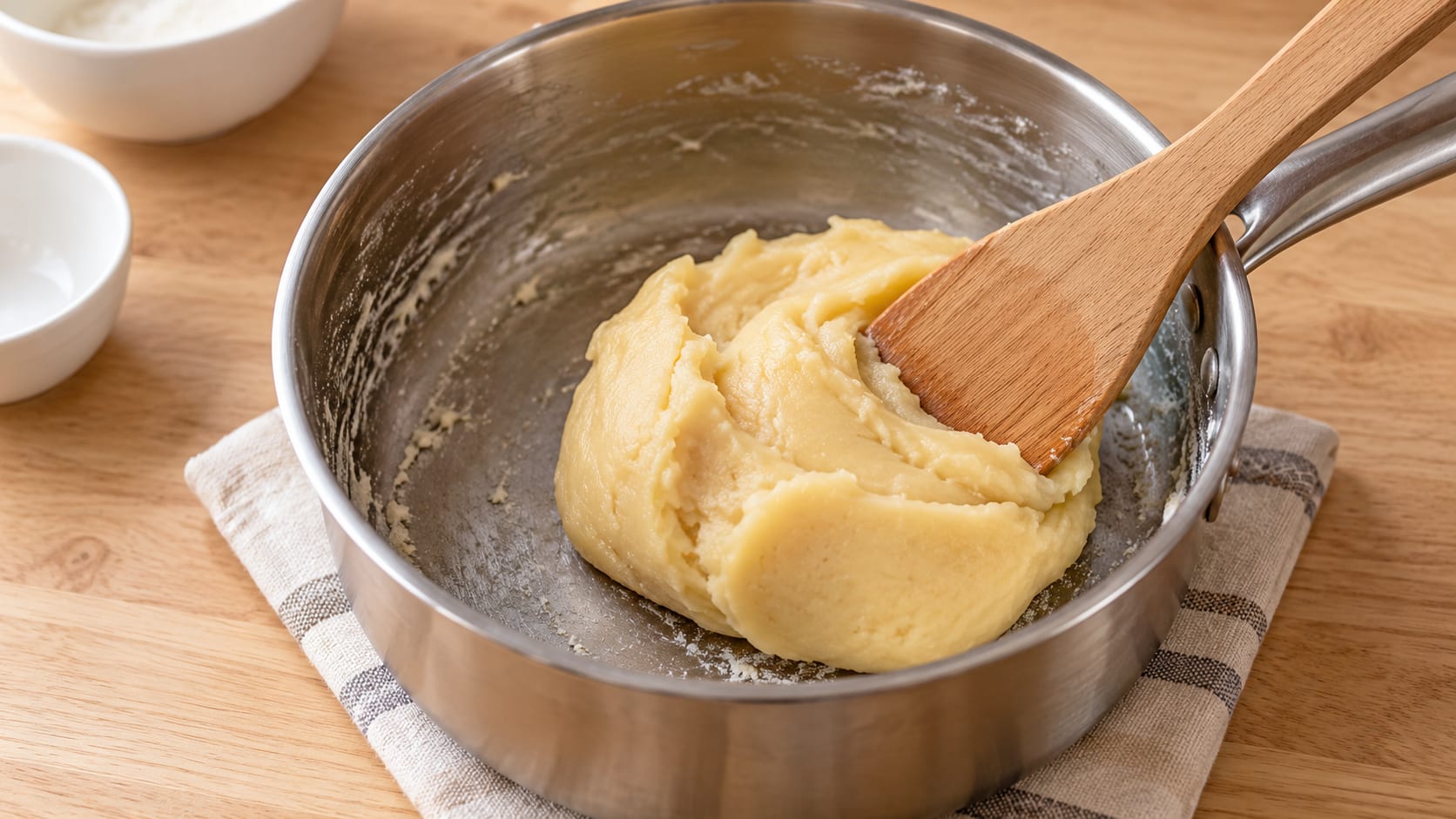 3. Cook the choux panade and let steam escape
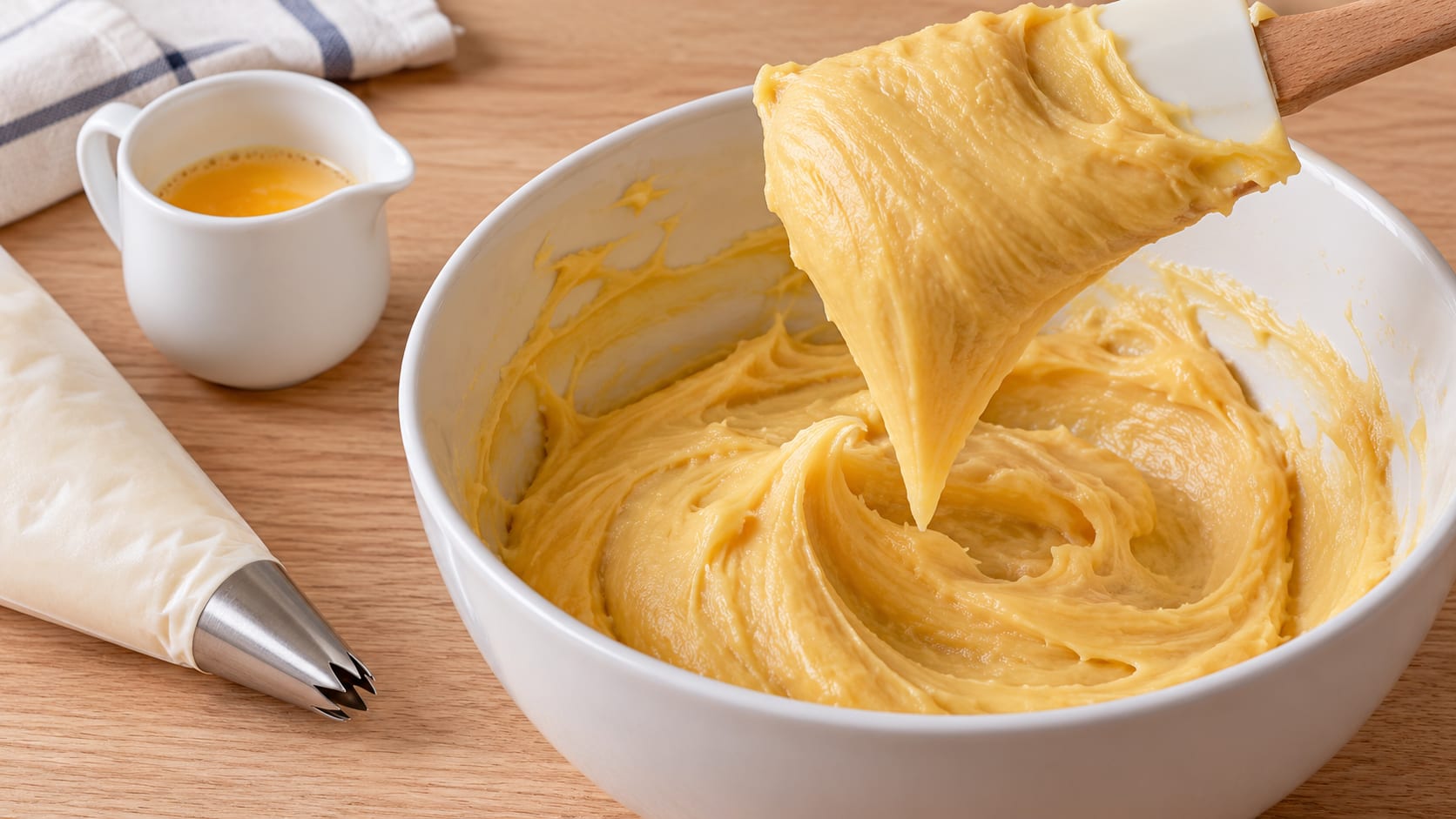 4. Add eggs to a thick V and pipe eight rings
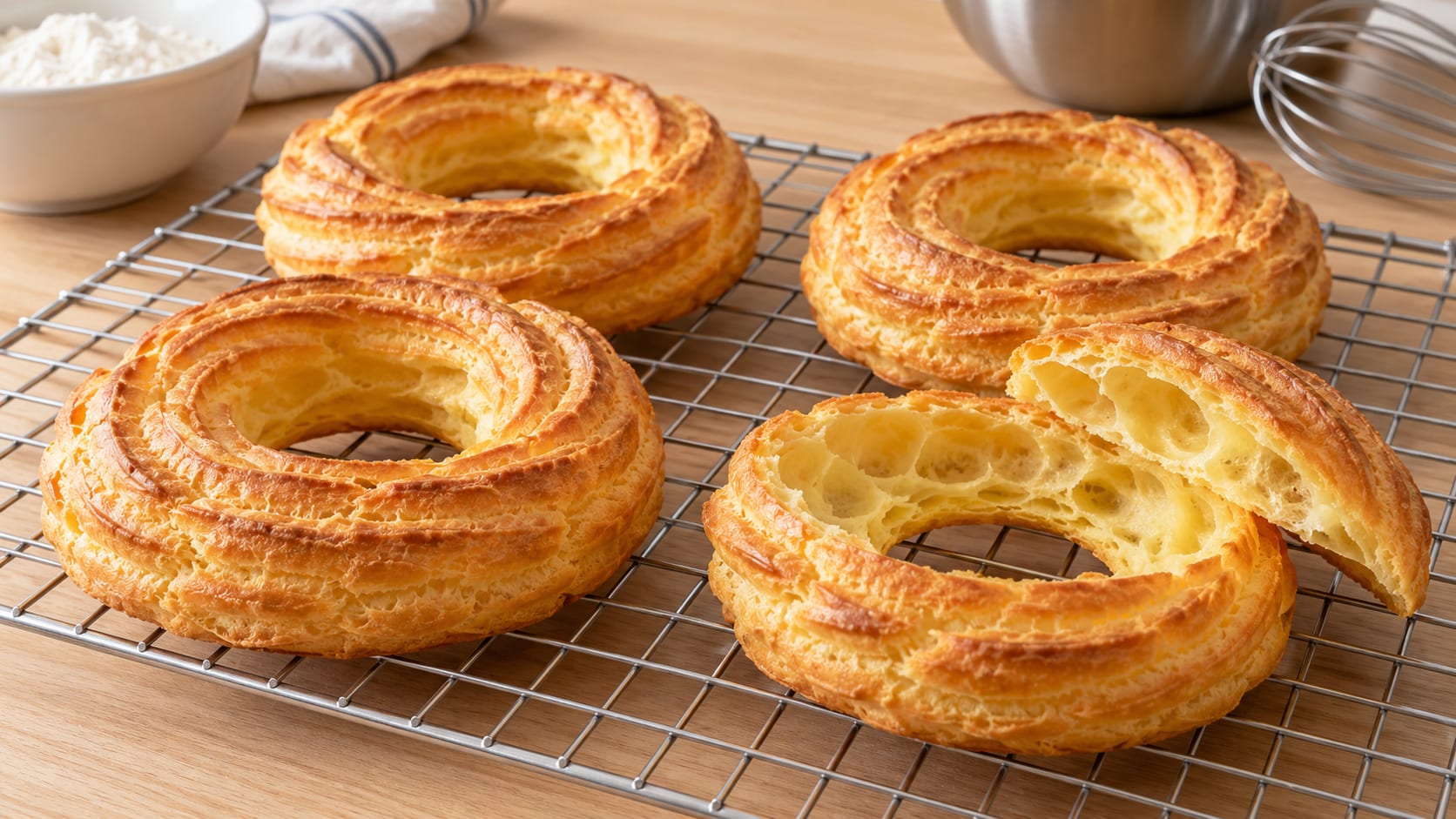 5. Bake until firm, vent, dry and cool
 6. Fill, crown with cherries and serve
Watch How To Make It

chefzelish.com
Baked Zeppole di San Giuseppe
Golden ridged choux rings filled with vanilla pastry cream, finished with a dark syrup cherry and a light dusting of sugar. Eight Italian bakery-style pastries made in the oven.
Ingredients
0 / 12 readyIngredient amounts for 8 filled zeppole
Vanilla pastry cream
Choux rings
Finish
Let’s make it.
- Vanilla pastry cream
Mix the yolks; temper with hot milk
Pour 350 g whole milk into a saucepan and heat until steaming with tiny edge bubbles. In a separate bowl whisk 60 g egg yolks with 70 g sugar until blended. Add all 30 g cornstarch and whisk to a smooth paste. Whisk a small stream of the hot milk into the yolk mixture, then gradually whisk in the rest. Pour everything back into the saucepan. Keep utensils that touched raw eggs separate from serving tools, and do not taste the raw mixture.
- Vanilla pastry cream
Cook the vanilla cream and chill it thoroughly
Heat the milk-and-yolk mixture over medium-low heat, whisking continuously into the corners. Once it thickens and slow bubbles break through, keep whisking at a gentle bubble for 60 seconds. The mixture must reach at least 71°C/160°F; this is cooked pastry cream, not a raw-egg filling. Remove from the heat and stir in all 4 g vanilla extract. Scrape into a clean shallow heatproof dish and press food-safe wrap against the surface. Cool the dish over an ice-water bath for about 15 minutes without letting water enter, then refrigerate at 4°C/40°F or below for at least 2 hours, until fully cold and firm. Refrigerate promptly and within 2 hours of cooking, or 1 hour above 32°C/90°F.
- Bake the choux rings
Cook the choux panade and let steam escape
Heat the oven to 200°C/390°F conventional. Line a large tray with at least 44 x 26 cm usable space with parchment; mark eight 7 cm circles on its underside, leaving at least 4 cm between circles. In a clean saucepan combine all 200 g water, 75 g butter and 2 g salt. Heat gently until the butter melts, then bring just to a boil. Add all 125 g flour at once. Stir vigorously over medium-low heat for 2 minutes, until the dough comes together and a thin film appears on the pan base. Transfer to a bowl, spread slightly and stir occasionally for 8–10 minutes, until warm rather than hot; it should no longer steam strongly before eggs are added.
- Bake the choux rings
Add eggs to a thick V and pipe eight rings
Weigh 180 g beaten whole egg. Add 150 g to the warm panade in three 50 g additions, beating well after each until the mixture comes back together. Add the remaining egg a teaspoon at a time only if needed. Stop when a lifted spatula leaves a thick, smooth V of dough hanging from its edge and a piped ridge holds its shape; it must not pour like batter. You may not need all 180 g. Record any unused egg; do not force it in or try to fix runny dough with raw flour. Transfer to a bag with a 14 mm open-star nozzle. Divide the dough evenly across the eight marked circles: pipe one ring, then another directly on top, leaving an open center about 2.5 cm wide. Use all the finished dough across the eight rings.
- Bake the choux rings
Bake until firm, vent, dry and cool
Bake the rings on the middle shelf at 200°C/390°F conventional for 15 minutes. Without opening the door, lower the setting to 180°C/355°F and continue for about 20–25 minutes, until well risen, deeply golden and firm. Keep the door closed for at least the first 30 minutes of baking. Once the shells are rigid, briefly remove the tray and pierce a small vent low on each ring with a clean skewer. Return to the 180°C oven for 5–8 minutes to dry the interiors; the pastry walls should be dry rather than wet and doughy. Times vary by oven and ring thickness, so extend the drying if needed. Move to a rack and cool completely, about 30 minutes. Never put custard into warm shells.
- Fill and finish
Fill, crown with cherries and serve
When both components are cold, gently stir the pastry cream just enough to make it pipeable. Split each cooled ring horizontally with a serrated knife. Pipe about two thirds of the total cream evenly into the eight lower halves, replace their pastry lids, then pipe the remaining third into a small rosette on each top. Use all the cream. Place one of the eight drained cherries on each rosette, sharing the measured 40 g across the batch without adding syrup. Sift all 12 g icing sugar over the eight pastries. Serve promptly for the best contrast between shell and cream. Keep filled pastries refrigerated at 4°C/40°F or below and use within 24 hours for quality. Keep chilled cream for no more than 2 days. Do not leave cream or filled pastries unrefrigerated for more than 2 hours, or 1 hour above 32°C/90°F.
Nutrition per serving
1 of 8 filled pastries; includes full choux egg allowance, drained cherries and sugar finish. Estimates may vary with ingredients and brands.
- Calories
- 271 kcal
- Protein
- 7.1 g
- Carbohydrates
- 30.3 g
- Fat
- 13.3 g
- Saturated fat
- 7 g
- Fiber
- 0.6 g
- Sugar
- 14.6 g
- Sodium
- 154 mg
Checked 10/27/2026. Values are per the serving described above, regardless of recipe yield.
Notes from the kitchen.
Helpful tips
Eight medium rings, about 7 cm before baking, piped in two stacked turns with an open 2.5 cm center. Plan about 45 minutes hands-on, 55 minutes cooking and at least 120 minutes cream chilling. Chilling overlaps pastry preparation; shells also need about 30 minutes to cool. Bake 15 minutes at 200°C/390°F conventional, then 20–25 minutes at 180°C/355°F, followed by 5–8 minutes drying once rigid. If your tray is smaller, pipe onto two trays and bake separately at the same temperatures; the second batch adds another full baking cycle. Prepare and bake choux promptly.
Make it your own
Contains wheat/gluten, milk and eggs. Check cherry and vanilla packaging for additional warnings. This method is for baked choux rings; it does not provide equivalent instructions for fried yeast zeppole. Use plain flour and pure cornstarch.
Storage & freezing
Cook the custard to a gentle bubble for 60 seconds and at least 71°C/160°F, then cool promptly and refrigerate at 4°C/40°F or below. Fill only completely cold shells with cold cream. Keep filled pastries refrigerated and use within 24 hours for quality; cream alone up to 2 days. Maximum unrefrigerated time is 2 hours, or 1 hour above 32°C/90°F.
At the table
Nutrition is an ingredient estimate for one of eight pastries, allocating all filling, 40 g drained cherries and 12 g icing sugar. It includes the full 180 g choux egg allowance even if a small portion is unused, so actual values can be slightly lower. Generic drained maraschino cherries are an explicit proxy for dark amarena-style cherries. No frying-oil uptake, extra syrup, ice-bath water, egg shells or unused yolk-separation whites are included.
A little something delicious.
Keep this recipe close for the next time the craving strikes.
Something else you’ll love.
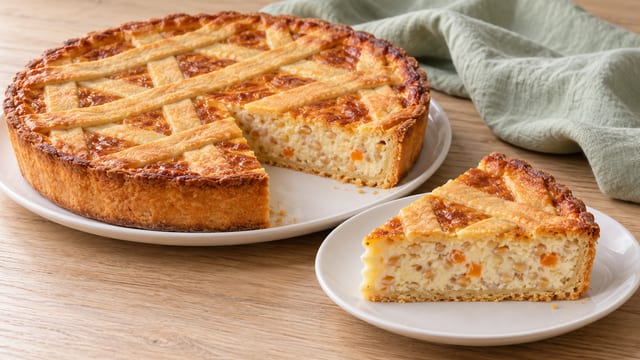
Pastiera Napoletana
Get the recipe
Risotto allo Zafferano
Get the recipe
0 Comments
No ratings yet
No comments yet. Have a question or tried this recipe? Leave a comment above.